Research
My research sits at the interface of condensed matter theory and quantum information science, with a focus on how locality, symmetry, and topology constrain entanglement in quantum many-body systems, both in and out of equilibrium. I am particularly interested in regimes where standard frameworks fail - fracton phases without conventional field-theoretic descriptions or intrinsically mixed-state phases - and where new forms of order and dynamical behaviour emerge. A unifying goal of my work is to develop non-perturbative frameworks for classifying many-body phases and to expose their potential as robust, noise-resilient platforms for quantum information storage and processing.
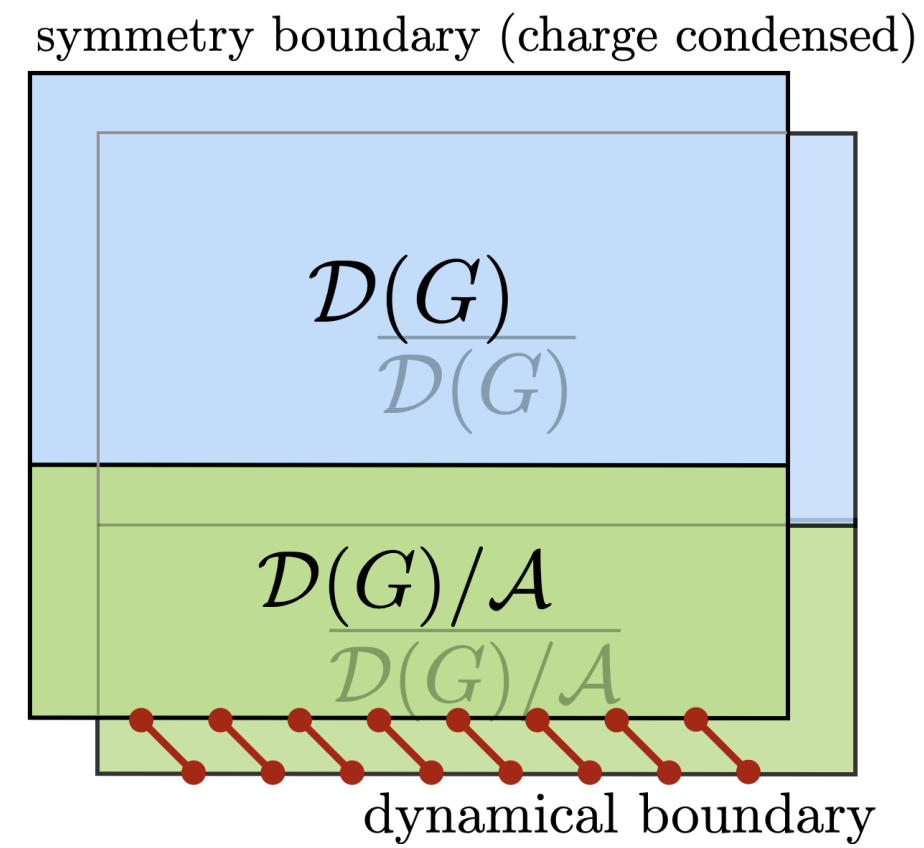
Holographic construction of mixed-state phases. A dynamical boundary of a folded bulk topological order $\mathcal{D}(G)\times\mathcal{D}(G)$, with partial anyon condensation $\mathcal{A}$, realizes an intrinsically mixed-state SPT phase.
Mixed-State Phases and Stable Quantum Memories
Real quantum systems are never perfectly isolated: they interact with their environment, are subjected to noise, and decohere. My work asks how defining features of topological phases (e.g., nonlocal order parameters or robustness to local perturbations) extend to such open settings, and whether noise itself can generate qualitatively new forms of order. This has led to the identification of intrinsically mixed-state topological order — phases that exist only in the presence of noise and have no pure-state analogue — as well as to mechanisms for stabilizing non-Abelian topological order using local Lindbladian dynamics.
More broadly, I develop non-perturbative frameworks for understanding phases of matter beyond the ground-state paradigm, where steady states and dynamical ensembles replace wavefunctions as the central objects. A unifying theme is that the same notions that protect topological states—symmetry and locality—can be harnessed to suppress errors, providing a direct bridge between the classification of non-equilibrium phases and the design of noise-resilient quantum memories.
Key papers: Noisy Approach to Mixed-State Topological Order · Steady-State Non-Abelian Topological Order · The Symmetry Taco · Stable SPT Steady-State Phases
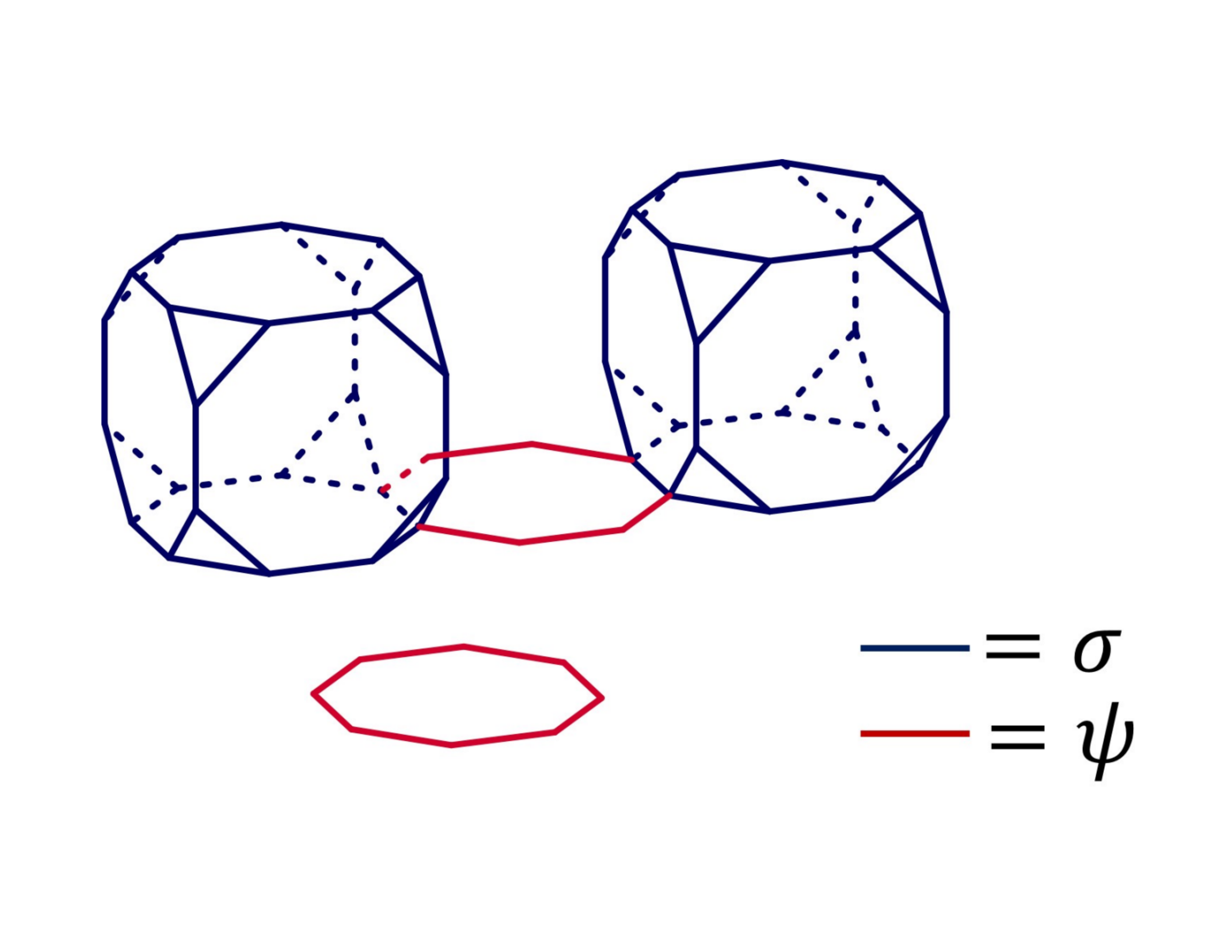
Cage-net construction of fracton order. Coupled layers of topological states produce excitations with subdimensional mobility.
Fractons: Classification and Dynamics
Fracton phases are exotic states of matter in which topological excitations exhibit severely restricted mobility: individual quasiparticles may be immobile, or confined to move only within lower-dimensional subspaces. This behaviour is enforced by higher-moment conservation laws and leads to striking phenomena, including quantum glassiness without disorder, an exponential ground-state degeneracy, and an unusual sensitivity to geometry that has no analogue in conventional topological order.
My work has helped establish both the classification and dynamics of these phases, including early studies of their glassy relaxation, the construction of cage-net models as exactly solvable lattice realizations of non-Abelian fracton order, and the unifying perspective of topological defect networks. I have also worked on their field-theoretic descriptions in terms of symmetric tensor gauge theories, including the exploration of their emergent phases and formulation on curved spaces, providing a bridge between lattice models and continuum frameworks.
Key papers: Cage-Net Fracton Models · Glassy Dynamics · Emergent Phases of Fractons · Symmetric Tensor Gauge Theories
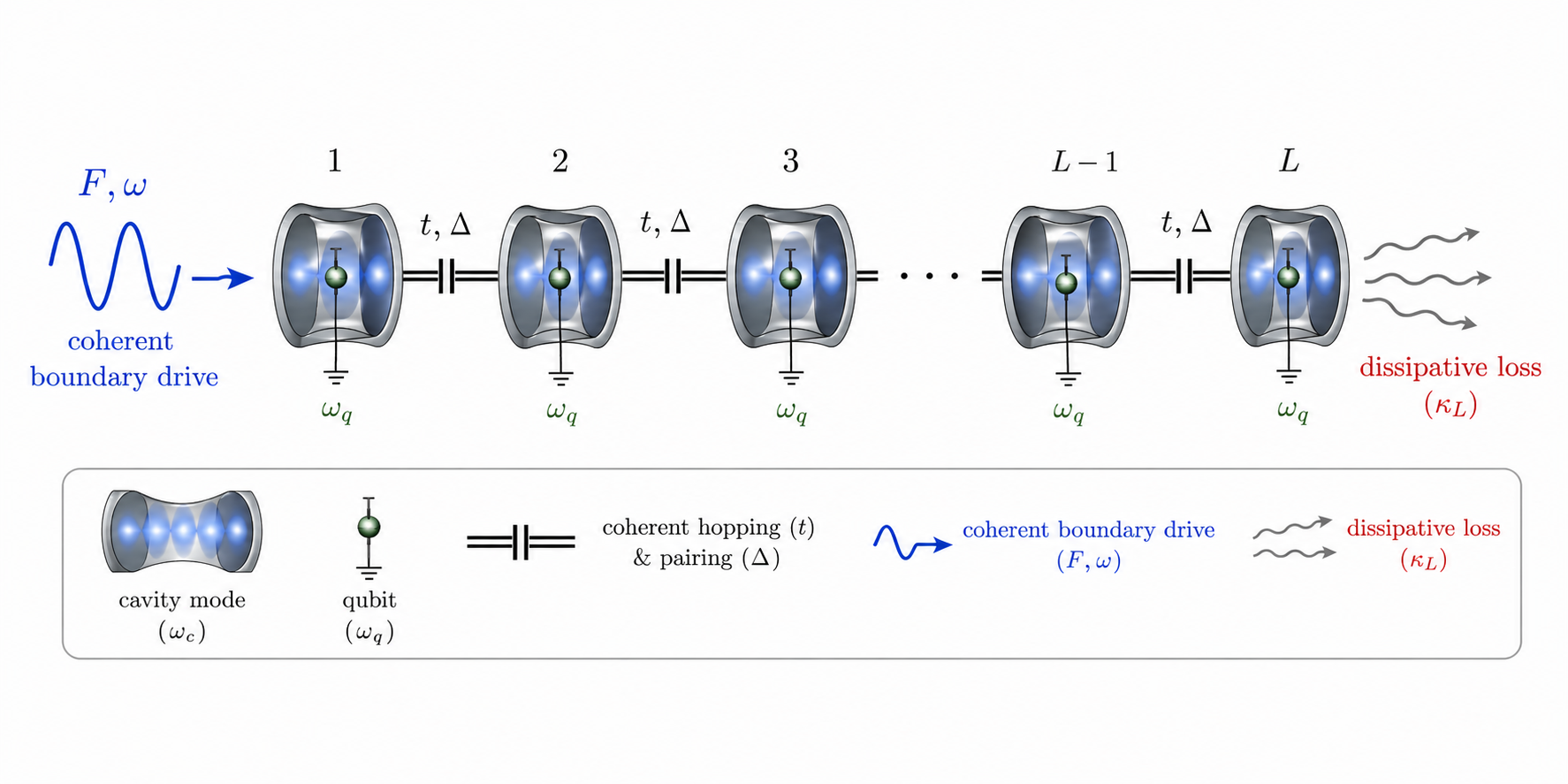
Local control of many-body dynamics in a cavity array. Coherent boundary driving competes with localized dissipation in a coupled cavity–qubit chain, generating non-equilibrium steady states and dynamical phase transitions.
Many-Body Dynamics in Driven and Open Systems
A central challenge in quantum many-body physics is understanding how complex systems evolve in time, particularly in regimes where they fail to thermalize. My work focuses on non-equilibrium dynamics in both driven (Floquet) and open quantum systems, where coherent evolution competes with dissipation and noise, leading to physics beyond conventional equilibrium descriptions.
I study how constraints on dynamics, arising from locality or symmetry, can restrict thermalization and give rise to non-ergodic behaviour. This includes the identification of Krylov-restricted thermalization as well as slow dynamics in symmetric quantum circuits. I have also shown that the interplay between local coherent driving and localized dissipation can stabilize novel steady states and induce dynamical and entanglement transitions in many-body systems.
Key papers: Krylov-restricted Thermalization · Spectral Statistics in Symmetric Circuits · Local-to-Global Entanglement Transitions · Temporal Entanglement Transitions
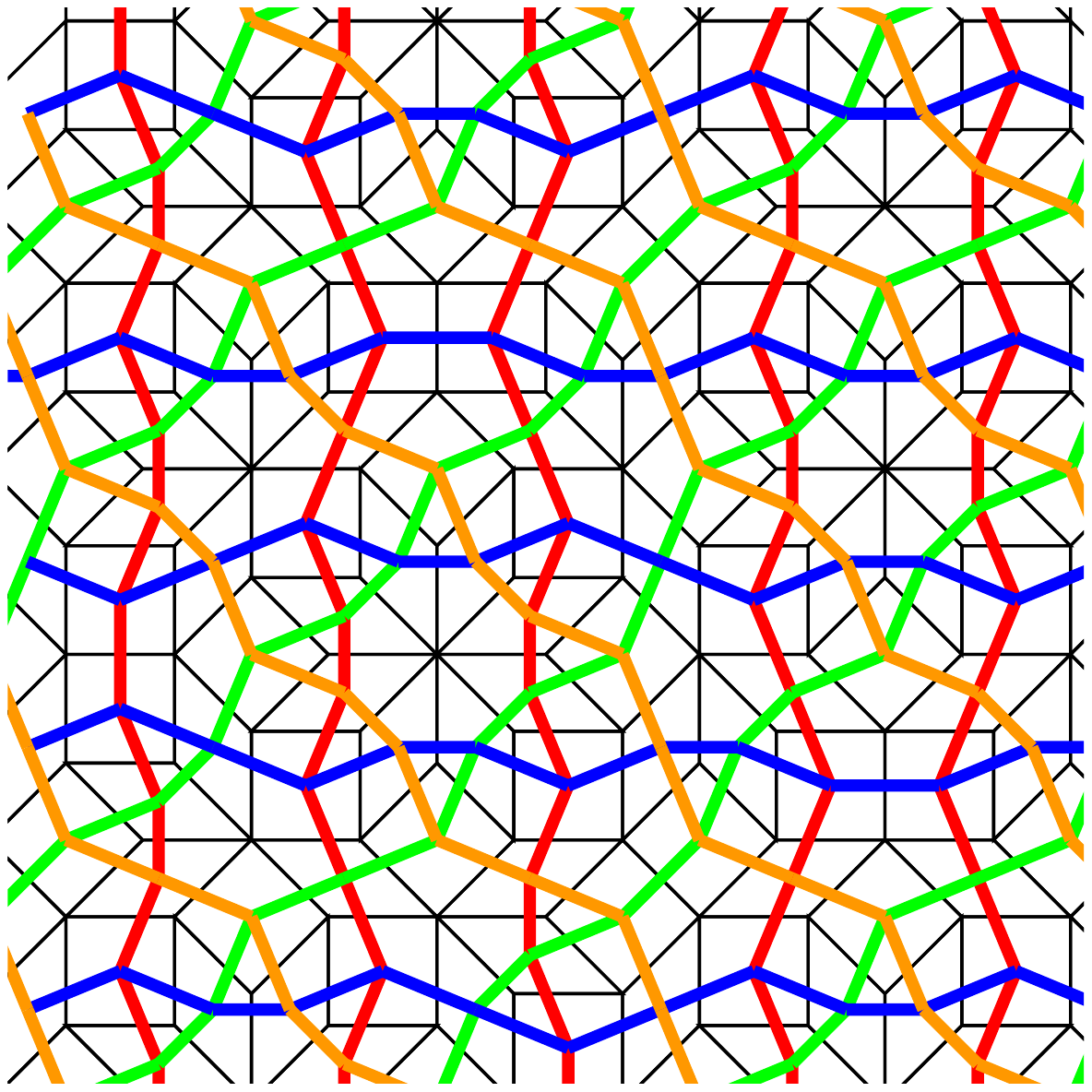
Topological phases on quasicrystalline lattices. Quasicrystals, despite lacking translational symmetry, support topological states with no crystalline analogue, protected by aperiodic order.
Topological Matter in Crystals and Aperiodic Systems
Topology in quantum matter is often studied in the presence of translation symmetry, but qualitatively new phenomena arise when this assumption is relaxed. My work investigates how geometry and symmetry beyond lattice translations—including crystalline symmetries, quasicrystalline order, and fractals—support novel topological phases of matter.
In these settings, topology becomes closely tied to spatial organization, giving rise to new boundary phenomena, defect physics, and bulk invariants. My contributions include studies of topological phases in quasicrystals and fractal lattices, as well as symmetry-protected phases stabilized by rotation and other crystalline symmetries. In particular, I showed that fractal lattices support topologically protected edge modes, and that quasicrystals, despite lacking translational symmetry, host topological phases with no crystalline counterparts.
Key papers: Quantum Many-Body Topology of Quasicrystals · Topological States on Fractals · Rotational Symmetry-Protected States